The IB Programme Model: How PYP, MYP, DP, and CP Build on Each Other
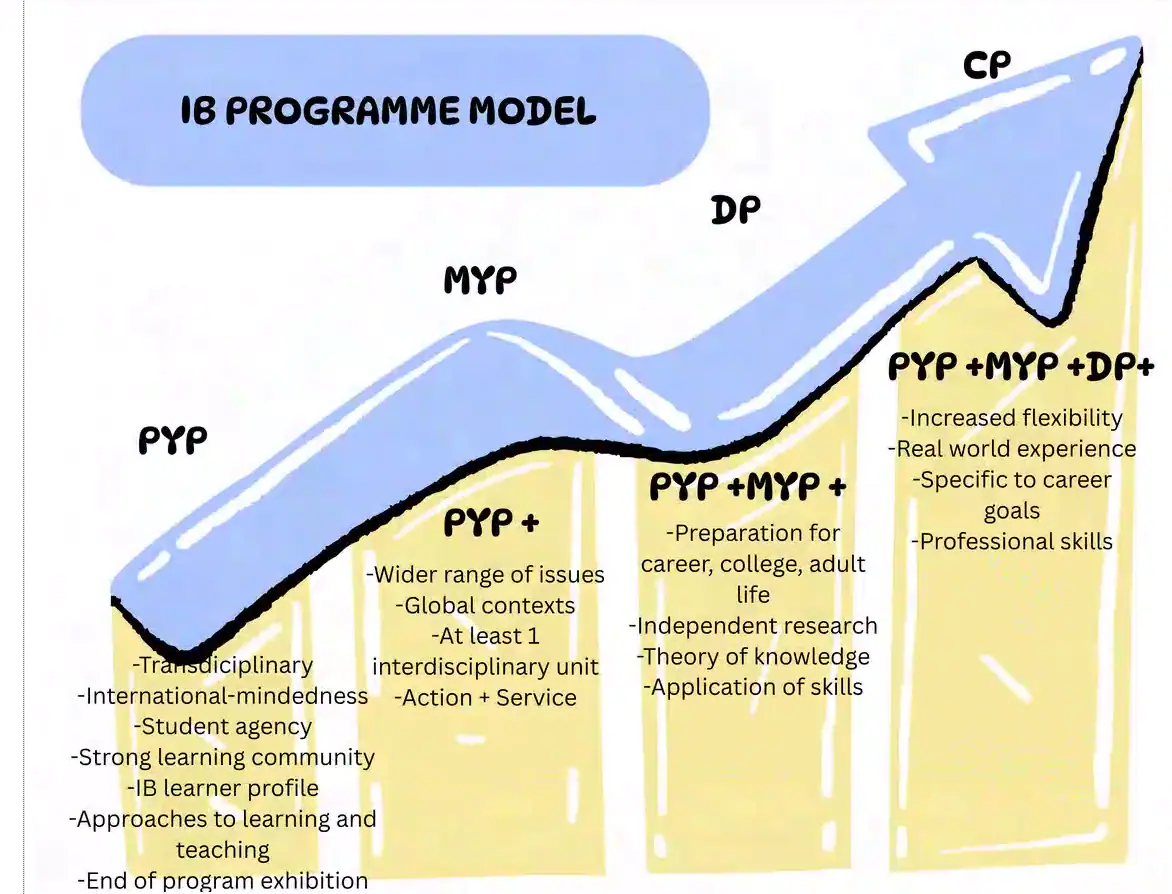
The International Baccalaureate is often described as four programmes. This IB Programme Model chart is more useful than that. It shows a rising path from the Primary Years Programme (PYP) through the Middle Years Programme (MYP) and Diploma Programme (DP) to the Career-related Programme (CP). Each stage keeps what came before and adds a new layer of demand: wider issues, independent research, then career-specific skill.
That is why emotional learning cannot be a PYP-only habit. The same student who needs agency and a strong learning community at age 8 will later need self-management for a Personal Project, composure for Theory of Knowledge, and professional regulation on a career pathway. The Mood Meter and the RULER approach travel with that arrow. They give students a shared language as the work gets harder.
A classroom Mood Meter poster and a Mood Meter & RULER spiral notebook help students check energy and pleasantness before inquiry, service, research, or workplace practice. Find more tools for emotional intelligence in school.
How to Read the Chart
The blue arrow is the continuum. The yellow columns are what accumulates. The first column is the PYP foundation. Each column to the right is labelled as PYP plus the next programme, then PYP + MYP +, then PYP + MYP + DP +. The point is not that older students abandon younger practices. It is that those practices stay in the stack while new ones are added.
This is a teaching diagram of growth, not a replacement for the official IB programme model graphic. Used well, it helps coordinators, teachers, and parents see why a skill taught in the PYP still matters in the DP, and why the CP is not a lesser path. It is a different destination built on the same base. For a map of what the three school programmes share at the centre, see IB core traits across PYP, MYP, and DP.
PYP: The Foundation the Rest of the Continuum Stands On
The first column lists the habits that should never disappear:
- Transdisciplinary learning
- International-mindedness
- Student agency
- A strong learning community
- The IB learner profile
- Approaches to learning and teaching
- The end-of-programme Exhibition
Transdisciplinary learning means young children investigate ideas that do not stay inside one subject. International-mindedness is the IB mission in daily form: curiosity about other people and a sense of shared humanity. Agency is voice, choice, and ownership. The learner profile names the kind of person the school is trying to grow. Approaches to Learning (ATL) are the skills underneath the units: thinking, research, communication, social skills, and self-management.
The Exhibition is the PYPu2019s culminating inquiry. Students investigate a real issue, work with mentors, and present to a community. That event is academic, social, and emotional at once. Children feel pride, nerves, frustration, and excitement, often in the same hour. If they have no way to name those states, agency turns into overwhelm. A Mood Meter check-in before Exhibition work is not a delay. It is how the foundation stays usable. Learn how to teach children to recognise emotions early.
Self-management, an ATL, is emotional regulation under another name. Students who can notice a red or blue mood and choose a strategy are already practising the skill the MYP Personal Project will require years later.
PYP +: What the MYP Adds
The second column is the MYP layer on top of the PYP:
- A wider range of issues
- Global contexts
- At least one interdisciplinary unit
- Action and service
Adolescents are asked to hold more complexity. Global contexts (identities and relationships, orientation in time and space, personal and cultural expression, scientific and technical innovation, globalisation and sustainability, fairness and development) stretch local inquiry toward the world. Interdisciplinary units ask students to use more than one subject to understand a problem. Action and service, including Service as Action and the Community Project, ask them to do something with what they know.
This is also when emotions get louder. Peer groups matter more. Identity is under construction. A wider range of issues can produce genuine care or genuine shutdown. Service without emotional awareness can become performance. Interdisciplinary work without regulation can become conflict about whose subject u201cwins.u201d
The Mood Meter helps here because it is specific. u201cThis unit is stressfulu201d can become u201cI am high-energy and unpleasant: anxious about the groupu2019s deadline.u201d That label points to a strategy: a smaller next step, a check-in with a teacher, or a pause before sending a sharp message. RULERu2019s Express skill keeps action and service ethical. Students learn to speak about impact without blaming. See what emotionally intelligent classrooms have in common.
PYP + MYP +: What the DP Adds
The third column is the Diploma Programme layer:
- Preparation for career, college, and adult life
- Independent research
- Theory of Knowledge
- Application of skills
The DP keeps the learner profile, ATL, international-mindedness, and service (now as CAS). It adds a heavier academic core: six subject groups, Theory of Knowledge, the Extended Essay, and CAS. Independent research is no longer a short project. It is months of reading, drafting, and sitting with uncertainty. TOK asks students to examine how knowledge is made, including the feelings that come with disagreement: curiosity, irritation, confidence, and doubt.
Preparation for college and adult life is not only about grades. It is about working when motivation dips, recovering after feedback, and staying in relationship with teachers and peers under deadline pressure. Those are regulation skills. DP stress often sits in the red quadrant of the Mood Meter: high energy, low pleasantness. If the only advice is u201cwork harder,u201d students skip the step that actually protects the essay.
Application of skills is where ATL becomes visible. A student who learned to label feelings in the PYP can now use that vocabulary in a CAS reflection, a TOK journal, or a supervisor meeting for the Extended Essay. Vague stress becomes a precise state and a usable plan. Try embedding emotional check-ins into academic lessons.
PYP + MYP + DP +: What the CP Adds
The fourth column is the Career-related Programme:
- Increased flexibility
- Real-world experience
- Learning specific to career goals
- Professional skills
The CP is built on the same IB foundation. Students still study DP courses, complete a core (including language development, service learning, a reflective project, and personal and professional skills), and follow a career-related study. The chart is right to place it at the top of the arrow rather than off to the side. Flexibility and workplace experience are additions, not a thinning of the continuum.
Professional skills are emotional skills in public. Showing up on time, receiving critique, collaborating with adults who are not teachers, and staying calm with clients or colleagues all require recognition and regulation. A Mood Meter check-in before a placement, a presentation, or a difficult conversation is the same practice as a PYP morning meeting, used in a more adult setting.
Real-world experience also raises the stakes of expression. Students must share needs clearly without sounding careless or defensive. That is RULERu2019s Express and Regulate skills applied to work, not only to classroom community. Read a complete guide to IB education.
The Learner Profile and ATL Run Through Every Column
Notice what the first column never drops. The IB learner profile and Approaches to Learning sit at the base because every later programme still needs them. Balanced, caring, reflective, and principled are not PYP words. They are how a DP student survives exam season and how a CP student represents a school on a work placement.
Self-management is the ATL that connects most directly to the Mood Meter. Communication is the ATL that connects most directly to RULERu2019s Label and Express. Social skills connect to community, service, and professional collaboration. When schools treat ATL as a poster and emotional learning as a separate lesson, the stack in this diagram splits. When they use one language for feelings across years, the stack holds. Explore reflective learning in the IB learner profile.
Using the Mood Meter at Each Stage of the Arrow
The Mood Meter maps feelings by energy and pleasantness. The quadrants stay the same from PYP to CP; only the situations change.
- Red (high energy, unpleasant): Exhibition nerves, group conflict in an MYP interdisciplinary unit, DP deadline panic, CP workplace frustration
- Blue (low energy, unpleasant): disappointment after feedback, fatigue during a long research stretch, discouragement after a placement setback
- Green (low energy, pleasant): calm focus during independent work, the quiet confidence that TOK and research require
- Yellow (high energy, pleasant): pride at a showcase, enthusiasm for a career task, the energy of a strong learning community
Teachers do not need a different tool for each programme. They need the same tool used with more independence. In the PYP, the class may plot a shared colour. In the MYP, students can log a personal check-in before project work. In the DP and CP, the notebook becomes a private regulation habit before assessments, interviews, or service.
Putting RULER on the Rising Path
RULERu2019s five skills scale with the chart.
Recognise
Notice body cues and classroom climate. A PYP class can point to the poster. A CP student can notice a tight chest before a client meeting.
Understand
Ask what caused the feeling. MYP service stress may come from an unclear role, not from u201cnot caring.u201d DP irritability may come from sleep loss, not from a weak research question.
Label
Use precise words. u201cStressedu201d might be anxious, ashamed, pressured, or tired. Better labels raise the quality of Exhibition reflection, MYP process journals, CAS entries, and CP professional reflections.
Express
Share needs without blame. That skill turns a strong learning community into a durable one, and later turns workplace feedback into a conversation instead of a shutdown.
Regulate
Match the strategy to the quadrant. High-energy anger needs a pause. Low-energy discouragement needs a smaller next step. Regulation is how the arrow keeps rising instead of stalling at the first hard task. Risk-taking in the learner profile depends on this kind of emotional courage.
How Schools Can Use This Diagram
Coordinators and teachers can treat the image as a planning tool.
- Audit the stack. For any unit, ask which column you are teaching and whether the PYP foundation is still visible: agency, community, learner profile, ATL.
- Do not drop the base in exam years. DP and CP calendars are crowded. That is when international-mindedness and emotional learning are most likely to be postponed. The chart argues the opposite: the higher the arrow, the more the base is needed.
- Connect culminating tasks. Exhibition, Community and Personal Projects, Extended Essay, and the CP reflective project are the same skill growing up. Use one reflection language across them.
- Explain CP as addition, not subtraction. Families sometimes hear u201ccareer-relatedu201d as a lesser IB. This diagram shows flexibility and professional skill stacked on PYP, MYP, and DP, not instead of them.
- Keep a visible feeling language. A Mood Meter beside the learner profile makes the first column practical. Students can practise community and self-management in the same glance.
Parents can use a simpler version of the same idea. You do not need IB jargon to ask, u201cWhich part of the path is this task on, and what colour are you right now?u201d That question supports agency in the PYP and professional self-management in the CP.
The Continuum Only Works If the Foundation Travels
The IB Programme Model in this chart is a growth story. PYP builds a transdisciplinary, internationally minded community with agency and an Exhibition. MYP adds global contexts, interdisciplinary thinking, and service. DP adds independent research, Theory of Knowledge, and preparation for adult academic life. CP adds flexibility, workplace experience, and professional skill.
None of those layers holds if students cannot notice, name, and regulate what they feel while they learn. The Mood Meter and RULER give the rising arrow a daily practice, so the foundation in the first column is still alive at the top.