IB Core Traits Across PYP, MYP, and DP: Why Emotional Learning Sits at the Centre
The International Baccalaureate is built as a continuum, not three disconnected programmes. The Primary Years Programme (PYP), Middle Years Programme (MYP), and Diploma Programme (DP) each have their own signature experiences, yet they rest on the same idea of the learner: a young person who inquires, collaborates, and grows in character as well as in subject knowledge.
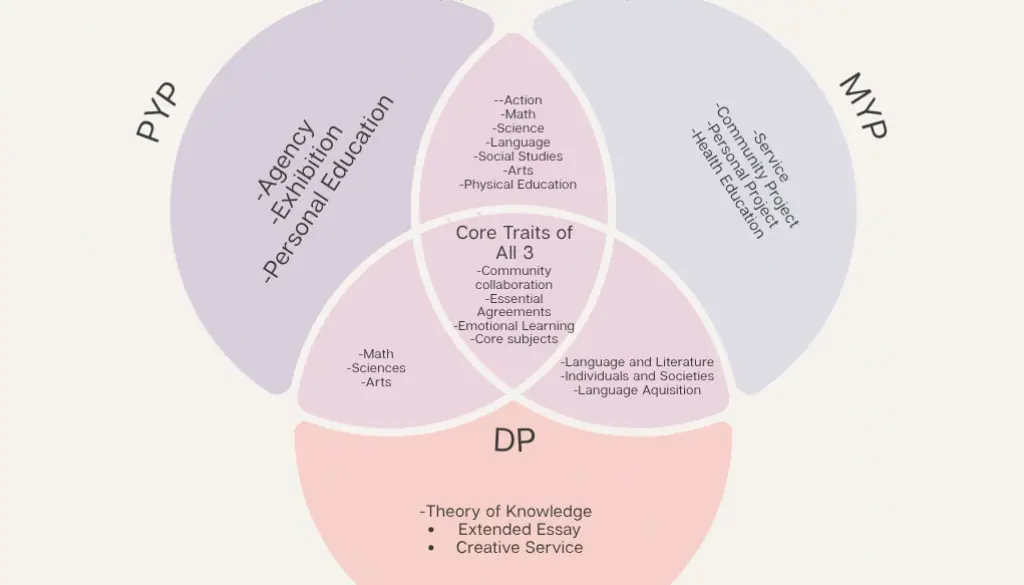
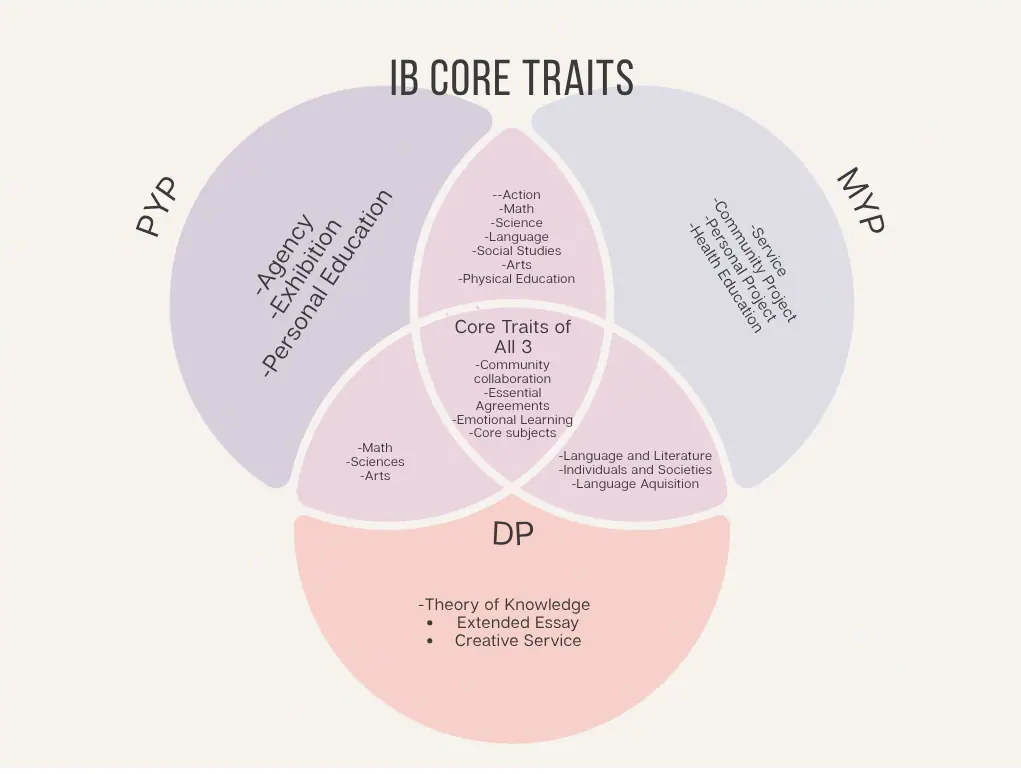
The IB Core Traits diagram below makes that overlap visible. Unique features sit in each circle. Shared subjects and practices fill the overlaps. At the very centre of all three programmes is a cluster of habits that never drop away, including community collaboration, essential agreements, core subjects, and emotional learning. That centre is where the Mood Meter and the RULER approach belong in an IB classroom.
A classroom Mood Meter poster and a Mood Meter & RULER spiral notebook give students a daily way to name feelings, reflect, and choose a better next step, from the PYP Exhibition through the DP Extended Essay. Explore classroom tools for emotional intelligence.
What the Diagram Is Showing
Read the image as a map of the IB continuum rather than as a list of every official IB course. Each coloured circle names the programme-specific work that students remember most: agency and the Exhibition in the PYP; service, the Community Project, and the Personal Project in the MYP; Theory of Knowledge, the Extended Essay, and service in the DP.
The overlaps show what travels with the student from one programme to the next. Maths, sciences, and the arts appear more than once because they are not u201cPYP subjectsu201d or u201cDP subjects.u201d They are part of a long academic spine. Language and literature, individuals and societies, and language acquisition sit where MYP and DP meet, as disciplinary study becomes more specialised.
The smallest, most important space is the centre labelled Core Traits of All 3. That is the argument of the diagram: if a school only copies the Exhibition, the Personal Project, or the Extended Essay, it has copied the landmarks. If it also teaches collaboration, shared agreements, and emotional learning, it is teaching the continuum.
PYP: Agency, Exhibition, and the Whole Child
In the PYP circle, three ideas stand out: agency, the Exhibition, and personal, social, and physical education. Agency is the PYP language for voice, choice, and ownership. Young learners help shape questions, decide how to show understanding, and take action that matters in their community.
The PYP Exhibition is the culminating inquiry, usually in the final year. Students investigate a real issue, work with mentors, and share learning with a wider audience. That process is academic, but it is also emotional. Children feel excitement, frustration, pride, and nerves, often in the same afternoon. Without a way to label those feelings, agency can collapse into overwhelm.
This is why emotional learning belongs in the PYP from the first years, not only at Exhibition time. A morning Mood Meter check-in helps a child notice whether they are calm enough to inquire, or whether they need a strategy first. That is the same skill older students will later use in MYP projects and DP assessments. Learn how to teach children to recognise emotions early.
MYP: Service, Projects, and Growing Independence
The MYP circle highlights service, the Community Project, the Personal Project, and health education. These are the years when students move from shared class inquiries toward more independent work. The Community Project (typically in MYP 3 or 4, depending on the school model) asks groups to take action with and for others. The Personal Project, at the end of the MYP, asks each student to set a goal, manage a process, and reflect on the product.
Those tasks demand Approaches to Learning that are easy to name and hard to practise: self-management, communication, and social skills. A student who cannot notice rising anxiety during a stalled Personal Project will often freeze, blame, or abandon the work. A student who can say u201cI am frustrated and low-energy, so I need a smaller next stepu201d is already doing MYP reflection.
Service learning is equally emotional. Caring is an IB learner profile trait, but caring without regulation can become burnout or performance. The Mood Meter helps students check whether they are acting from empathy, from pressure, or from a need to look busy. That honesty makes service more ethical, not less ambitious.
DP: TOK, the Extended Essay, and CAS
The DP circle names the programme core: Theory of Knowledge (TOK), the Extended Essay, and service through CAS (Creativity, Activity, Service), shown on the diagram as creative service. These are the experiences that ask 16- to 19-year-olds to think about knowledge, sustain a long research argument, and live a balanced life beside demanding courses.
TOK is not only an epistemology course. It is a training ground for intellectual humility and for the emotions that come with disagreement: curiosity, irritation, confidence, and doubt. The Extended Essay rewards students who can sit with uncertainty for months. CAS asks them to stay human while doing so.
DP stress often looks like high energy and low pleasantness on the Mood Meter: anxious, overwhelmed, or irritable. If the only response is u201cwork harder,u201d students miss the regulation step that actually protects the essay. A short check-in before a TOK discussion or a CAS reflection can turn a vague u201cI am stressedu201d into a precise label and a usable strategy. See how emotional awareness helps under pressure.
Where the Programmes Overlap
PYP and MYP: Action and Transdisciplinary Subjects
The top overlap lists action, mathematics, science, language, social studies, arts, and physical education. In both programmes, subjects are a means of inquiry, not only a timetable. Action is the shared expectation that learning should change something: a habit, a relationship, a community practice, or a studentu2019s own thinking.
Emotional learning makes action safer. Students who can name feelings are less likely to confuse a strong emotion with a finished decision. They can still protest, create, or serve, but they do it with more self-awareness.
PYP and DP: The Long Academic Spine
The lower-left overlap keeps mathematics, sciences, and arts in view across the youngest and oldest IB years. A PYP student painting to express a unit of inquiry and a DP student analysing a visual arts process are not doing the same task. They are practising the same idea: knowledge is made, not only received, and making it involves feeling as well as thinking.
MYP and DP: Disciplinary Depth
The lower-right overlap names language and literature, individuals and societies, and language acquisition. Here the continuum becomes more subject-specific. MYP criteria and DP assessments look different, but both ask students to interpret texts, understand people in context, and communicate across languages.
Those subjects are full of emotion words, even when the markscheme never says so. A literature commentary, a history source analysis, and a language oral all require students to read feeling in themselves and in others. Accurate emotional vocabulary is an academic tool, not a soft extra. Read how the IB learner profile trait of risk-taker depends on emotional courage.
The Centre: Why Emotional Learning Is a Core Trait
The diagram places four items in the centre of PYP, MYP, and DP:
- Community collaboration
- Essential agreements
- Emotional learning
- Core subjects
Essential agreements are the classroomu2019s shared rules for how people treat one another. They only work if students can notice when they are about to break them. Collaboration only works if students can repair after conflict. Core subjects only stay accessible if a student can regulate enough to think.
Emotional learning is therefore not a fourth programme sitting beside PYP, MYP, and DP. It is the condition that lets the other core traits function. This is also the IB learner profile in practice. Balanced learners look after well-being. Caring learners notice others. Reflective learners review their own responses. Communicators name inner states with precision. Explore reflective learning through the IB learner profile.
How the Mood Meter Fits the IB Continuum
The Mood Meter maps feelings along two axes: energy and pleasantness. That simple grid gives IB students a shared language that works at age 6 and at age 18.
- Red (high energy, unpleasant): anger, anxiety, frustration during a stalled project or a difficult TOK seminar
- Blue (low energy, unpleasant): disappointment, fatigue, or discouragement after feedback
- Green (low energy, pleasant): calm, focus, and contentment during independent work
- Yellow (high energy, pleasant): excitement, pride, and enthusiasm at an Exhibition, a Personal Project showcase, or CAS event
Because the tool is visual, it supports multilingual IB classrooms and students who are still building academic English. Because it is specific, it improves reflection writing in PYP portfolios, MYP process journals, and DP CAS reflections. Vague sentences such as u201cI felt badu201d become u201cI was in the red: overwhelmed and short on time, so I asked for a checkpoint.u201d
Teachers can keep the chart visible beside learner profile attributes and essential agreements. The point is not to add another display. The point is to give the centre of the IB Core Traits diagram a daily practice. See what emotionally intelligent classrooms have in common.
Using RULER With PYP, MYP, and DP Tasks
RULER is the five-skill framework that sits behind the Mood Meter: Recognising, Understanding, Labelling, Expressing, and Regulating emotions. Each skill maps cleanly onto IB work.
Recognise
Notice body cues and classroom climate before a task begins. A PYP class can point to the Mood Meter. An MYP advisory can do a 30-second check-in before Personal Project work. A DP teacher can ask, u201cWhere is the room right now?u201d before a timed assessment.
Understand
Ask what caused the feeling. Exhibition nerves may come from an unfinished board, not from the topic itself. Extended Essay irritability may come from sleep loss, not from a u201cbadu201d research question. Understanding prevents students from abandoning work that is actually salvageable.
Label
Swap broad words for precise ones. u201cStressedu201d might be anxious, pressured, ashamed, or simply tired. Better labels produce better next steps, and they raise the quality of learner-profile reflection.
Express
Practise sharing feelings without blaming. Essential agreements become real when a student can say, u201cI felt left out when the group moved on without me,u201d instead of shutting down. That is community collaboration in the centre of the diagram.
Regulate
Choose a strategy that matches the quadrant. High-energy anger may need a pause and a walk. Low-energy discouragement may need a smaller goal and a peer check. Regulation is how students stay balanced through long IB tasks. Try embedding emotional check-ins into academic lessons.
Putting the Diagram to Work in School
Teachers, coordinators, and parents can use the IB Core Traits image as a planning tool, not only as a poster.
- Map one unit onto the diagram. Ask which circle you are standing in, which overlap you are drawing on, and how emotional learning will be practised, not merely mentioned.
- Keep essential agreements alive. Revisit them when the class is in the red, not only on the first day. Agreements that never meet a real feeling stay decorative.
- Connect culminating tasks. Show students how PYP Exhibition reflection, MYP project journals, and DP CAS/EE reflections are the same skill growing up. The Mood Meter can be the through-line.
- Protect the centre during high-stakes seasons. Mock exams and deadline weeks are when emotional learning is most likely to be dropped. That is exactly when the centre of the diagram is most needed.
- Share the language at home. Parents do not need IB jargon to ask, u201cWhat colour are you right now, and what would help?u201d That question supports agency in the PYP and self-management in the DP.
Used this way, the diagram is honest about difference and firm about sameness. PYP is not a mini DP. MYP is not a waiting room. Each programme has its own craft. What they share is a core: people learning together, under agreements they can keep, with feelings they can name, while they study demanding things.
Emotional Learning Holds the Continuum Together
The IB Core Traits chart is a reminder that the continuum is more than a sequence of badges. Agency, projects, TOK, and the Extended Essay only produce internationally minded students if the inner circle is taught with the same seriousness as the outer circles.
Community collaboration, essential agreements, core subjects, and emotional learning are the traits that should still be visible when the programme names change. The Mood Meter and RULER give schools a concrete way to teach that centre every day, so students do not only complete IB milestones. They grow the self-awareness those milestones require.