Inside the International Baccalaureate
International Baccalaureate (IB) Explained
The International Baccalaureate (IB) is a globally recognized educational foundation offering a continuum of rigorous, inquiry-based academic programs aimed at developing internationally minded learners. With a commitment to high standards and holistic development, IB equips students with the critical thinking skills, multilingual proficiency, and global awareness necessary for success in the modern world.
What Is the International Baccalaureate?
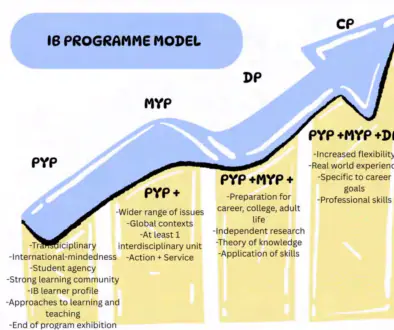
Founded in 1968 in Geneva, Switzerland, the International Baccalaureate Organization (IBO) offers four academic programs for students aged 3 to 19:
Primary Years Programme (PYP): Ages 3–12
Middle Years Programme (MYP): Ages 11–16
Diploma Programme (DP): Ages 16–19
Career-related Programme (CP): Ages 16–19
These programs emphasize intellectual challenge, intercultural understanding, and independent learning.
IB Learner Profile: Core Values in Action
The IB Learner Profile defines ten attributes that reflect the holistic aims of the program. These traits are deeply embedded across all IB programs:
Inquirers
Knowledgeable
Thinkers
Communicators
Principled
Open-minded
Caring
Risk-takers
Balanced
Reflective
These attributes support the development of responsible, ethical, and globally competent citizens.
The IB Curriculum: Framework and Structure
Primary Years Programme (PYP)
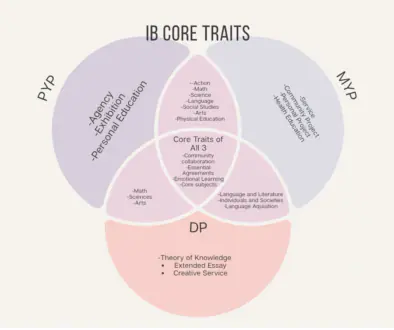
Transdisciplinary themes integrate multiple subject areas.
Concept-based inquiry fosters deep understanding through exploration.
Student agency is central learners co-construct their educational journey.
Middle Years Programme (MYP)
Structured around eight subject groups:
Language and Literature
Language Acquisition
Individuals and Societies
Sciences
Mathematics
Arts
Physical and Health Education
Design
Global contexts drive relevance in learning.
Community projects and personal projects enhance autonomy and responsibility.
Diploma Programme (DP)
Six subject groups:
Language and Literature
Language Acquisition
Individuals and Societies
Sciences
Mathematics
Arts or elective subject
Core components:
Theory of Knowledge (TOK): Develops critical thinking about knowledge.
Extended Essay (EE): 4,000-word independent research paper.
Creativity, Activity, Service (CAS): Experiential learning through real-world engagement.
Career-related Programme (CP)
Tailored for students interested in career-specific education.
Combines DP courses with career-related studies.
Includes a Reflective Project, Language Development, Service Learning, and Personal and Professional Skills.
IB Assessment and Grading System
IB uses criterion-referenced assessment, meaning student performance is measured against pre-defined criteria rather than a curve. Key points:
Internal assessments: Teacher-marked, externally moderated.
External assessments: Include essays, structured problems, data responses, and case studies.
DP scoring: Max score is 45 (6 subjects x 7 points + 3 core points).
A score of 24 points is the minimum for diploma qualification.
Global Recognition of the IB
Accepted in over 5,000 universities across 100+ countries.
Highly regarded by elite institutions like Harvard, Oxford, and MIT.
Seen as a gold standard for academic rigor and college readiness.
Benefits of an IB Education
Academic excellence: Encourages depth and breadth across disciplines.
Global citizenship: Promotes intercultural understanding and respect.
Critical thinking: Builds advanced analytical and evaluative capabilities.
Multilingualism: Reinforces communication in more than one language.
College readiness: Prepares students for the demands of university-level work.
IB School Authorization and Standards
Schools must undergo a strict authorization process to offer IB programs, involving:
Curriculum alignment
Staff training and certification
Regular evaluations and school visits
This ensures consistency and quality across all IB World Schools globally.
The IB Advantage in the 21st Century
We believe IB education is more relevant than ever in preparing students for complex global challenges. With a balanced approach between academic knowledge and real-world application, IB fosters compassionate leaders, resilient problem solvers, and culturally agile thinkers.
Whether aiming for top-tier university admission, entering the workforce, or becoming a change-maker, IB learners are equipped to thrive.